Wichtig
Übersetzen ist eine Gemeinschaftsleistung Sie können mitmachen. Diese Seite ist aktuell zu 44.28% übersetzt.
24.1.6. Fix Geometry
24.1.6.1. Add missing vertices along borders
Added in 3.42
Adds the missing vertices along polygons borders, based on an error layer from the Missing vertices along borders algorithm.
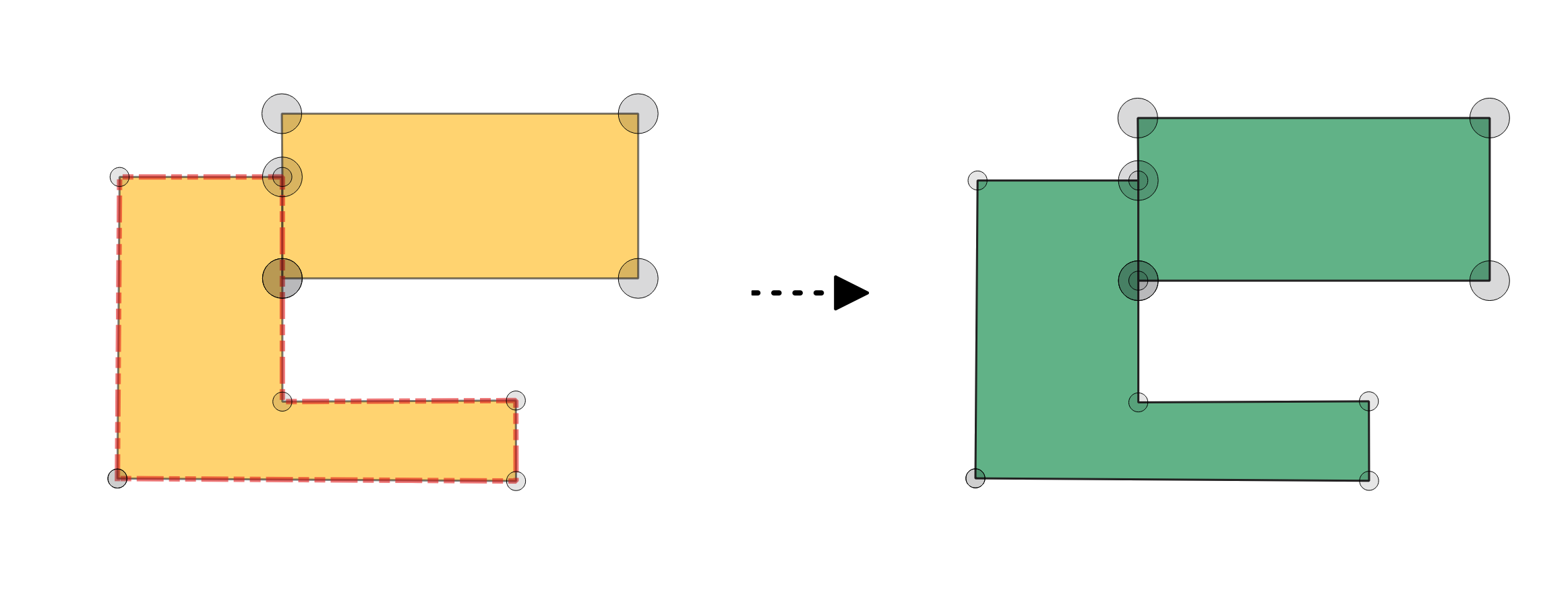
Abb. 24.16 Fixing missing vertices along polygon borders.
Parameter
Grundlegende Parameter
Bezeichnung |
Name |
Typ |
Beschreibung |
|---|---|---|---|
Eingabelayer |
|
[Vektor: Polygon] |
Layer with the geometries to fix, same as input in the check algorithm. |
Error layer |
|
[Vektor: Punkt] |
Point layer with the errors location, generated by the check algorithm. |
Field of original feature unique identifier |
|
[tablefield: any] |
Field storing unique values for feature identification in input layer, as set in the check algorithm. |
Field of part index |
|
[tablefield: integer] Default: |
Field storing the erroneous feature’s geometry part number. |
Field of ring index |
|
[tablefield: integer] Default: |
Field storing the erroneous feature’s geometry ring number. |
Field of vertex index |
|
[tablefield: integer] Default: |
Field storing the erroneous feature’s geometry vertex number. |
Border vertices fixed layer |
|
[Vektor: Polygon] Standard: |
Specification of the output layer containing fixed features. One of:
Die Kodierung der Datei kann ebenfalls hier geändert werden. |
Report layer from fixing border vertices |
|
[Vektor: Punkt] Standard: |
Specification of the output layer containing the fixes location. One of:
Die Kodierung der Datei kann ebenfalls hier geändert werden. |
Fortgeschrittene Parameter
Bezeichnung |
Name |
Typ |
Beschreibung |
|---|---|---|---|
Tolerance |
|
[numerisch: Ganzzahl] Default: 8 |
Numerical precision of geometric operations, given as an integer n, meaning that two vertices less than 10-n apart (in map units) are considered to be merged. |
Ausgaben
Bezeichnung |
Name |
Typ |
Beschreibung |
|---|---|---|---|
Report layer from fixing border vertices |
|
[Vektor: Punkt] |
Output point layer representing the error locations and fix applied. The output layer contains the following fields:
|
Border vertices fixed layer |
|
[Vektor: Polygon] |
Output layer with the geometry fix applied to the input features. The layer contains the same fields as in the input layer. |
Python-Code
Algorithm ID: native:fixgeometrymissingvertex
import processing
processing.run("algorithm_id", {parameter_dictionary})
Die Algorithmus-Kennung wird angezeigt, wenn Sie den Mauszeiger über den Algorithmus in der Verarbeitungs-Werkzeugkiste bewegen. Die Parameter-Liste (parameter_dictionary) enthält die Namen und Werte der Parameter. Siehe Verarbeitungs-Algorithmen von der Konsole aus verwenden für Details zur Ausführung von Verarbeitungsalgorithmen über die Python-Konsole.
24.1.6.2. Convert to strictly multipart
Added in 3.42
Converts multipart geometries that consists of only one geometry into singlepart geometries, based on an error layer from the Strictly multipart algorithm. Layer geometry type will not be changed and will remain multipart.
Siehe auch
Parameter
Grundlegende Parameter
Bezeichnung |
Name |
Typ |
Beschreibung |
|---|---|---|---|
Eingabelayer |
|
[vector: line, polygon] |
Layer with the geometries to fix, same as input in the check algorithm. |
Error layer |
|
[Vektor: Punkt] |
Point layer with the errors location, generated by the check algorithm. |
Field of original feature unique identifier |
|
[tablefield: any] |
Field storing unique values for feature identification in input layer, as set in the check algorithm. |
Strictly-multipart layer |
|
[vector: same as input] Standard: |
Specification of the output layer containing fixed features. One of:
Die Kodierung der Datei kann ebenfalls hier geändert werden. |
Report layer from fixing multipart |
|
[Vektor: Punkt] Standard: |
Specification of the output layer containing the centroids of the fixed geometries. One of:
Die Kodierung der Datei kann ebenfalls hier geändert werden. |
Fortgeschrittene Parameter
Bezeichnung |
Name |
Typ |
Beschreibung |
|---|---|---|---|
Tolerance |
|
[numerisch: Ganzzahl] Default: 8 |
Numerical precision of geometric operations, given as an integer n, meaning that two vertices less than 10-n apart (in map units) are considered to be merged. |
Ausgaben
Bezeichnung |
Name |
Typ |
Beschreibung |
|---|---|---|---|
Report layer from fixing multipart |
|
[Vektor: Punkt] |
Output point layer representing the error locations and fix applied. The output layer contains the following fields:
|
Strictly-multipart layer |
|
[vector: same as input] |
Output layer with the geometry fix applied to the input features. The layer contains the same fields as in the input layer. |
Python-Code
Algorithm ID: native:fixgeometrymultipart
import processing
processing.run("algorithm_id", {parameter_dictionary})
Die Algorithmus-Kennung wird angezeigt, wenn Sie den Mauszeiger über den Algorithmus in der Verarbeitungs-Werkzeugkiste bewegen. Die Parameter-Liste (parameter_dictionary) enthält die Namen und Werte der Parameter. Siehe Verarbeitungs-Algorithmen von der Konsole aus verwenden für Details zur Ausführung von Verarbeitungsalgorithmen über die Python-Konsole.
24.1.6.3. Delete duplicated vertices
Added in 3.42
Deletes duplicated vertices from the input geometries, based on errors reported by the Duplicated vertices algorithm.
Siehe auch
Parameter
Grundlegende Parameter
Bezeichnung |
Name |
Typ |
Beschreibung |
|---|---|---|---|
Eingabelayer |
|
[vector: line, polygon] |
Layer with the geometries to fix, same as input in the check algorithm. |
Error layer |
|
[Vektor: Punkt] |
Point layer with the errors location, generated by the check algorithm. |
Field of original feature unique identifier |
|
[tablefield: any] |
Field storing unique values for feature identification in input layer, as set in the check algorithm. |
Field of part index |
|
[tablefield: integer] Default: |
Field storing the erroneous feature’s geometry part number. |
Field of ring index |
|
[tablefield: integer] Default: |
Field storing the erroneous feature’s geometry ring number. |
Field of vertex index |
|
[tablefield: integer] Default: |
Field storing the erroneous feature’s geometry vertex number. |
Fixed duplicate vertices layer |
|
[vector: same as input] Standard: |
Specification of the output layer containing fixed features. One of:
Die Kodierung der Datei kann ebenfalls hier geändert werden. |
Report layer from fixing duplicate vertices |
|
[Vektor: Punkt] Standard: |
Specification of the output layer containing the fixes location. One of:
Die Kodierung der Datei kann ebenfalls hier geändert werden. |
Fortgeschrittene Parameter
Bezeichnung |
Name |
Typ |
Beschreibung |
|---|---|---|---|
Tolerance |
|
[numerisch: Ganzzahl] Default: 8 |
Numerical precision of geometric operations, given as an integer n, meaning that two vertices less than 10-n apart (in map units) are considered to be merged. |
Ausgaben
Bezeichnung |
Name |
Typ |
Beschreibung |
|---|---|---|---|
Report layer from fixing duplicate vertices |
|
[Vektor: Punkt] |
Output point layer representing the error locations and fix applied. The output layer contains the following fields:
|
Fixed duplicate vertices layer |
|
[vector: same as input] |
Output layer with the geometry fix applied to the input features. The layer contains the same fields as in the input layer. |
Python-Code
Algorithm ID: native:fixgeometryduplicatenodes
import processing
processing.run("algorithm_id", {parameter_dictionary})
Die Algorithmus-Kennung wird angezeigt, wenn Sie den Mauszeiger über den Algorithmus in der Verarbeitungs-Werkzeugkiste bewegen. Die Parameter-Liste (parameter_dictionary) enthält die Namen und Werte der Parameter. Siehe Verarbeitungs-Algorithmen von der Konsole aus verwenden für Details zur Ausführung von Verarbeitungsalgorithmen über die Python-Konsole.
24.1.6.4. Delete features
Added in 3.42
Deletes error features based on an error layer from some check geometry algorithms, such as:
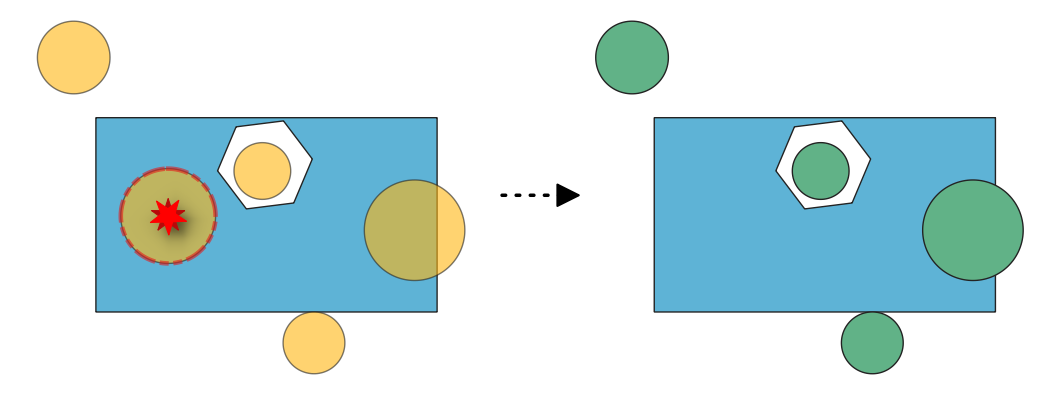
Abb. 24.17 Fixing errors from the „Features inside polygon“ algorithm check.
Siehe auch
Parameter
Grundlegende Parameter
Bezeichnung |
Name |
Typ |
Beschreibung |
|---|---|---|---|
Eingabelayer |
|
[Vektor: Geometrie] |
Layer with the geometries to fix, same as input in the check algorithm. |
Error layer |
|
[Vektor: Punkt] |
Point layer with the errors location, generated by the check algorithm. |
Field of original feature unique identifier |
|
[tablefield: any] |
Field storing unique values for feature identification in input layer, as set in the check algorithm. |
Cleaned layer |
|
[vector: same as input] Standard: |
Specification of the output layer containing fixed features. One of:
Die Kodierung der Datei kann ebenfalls hier geändert werden. |
Report layer from deleting features |
|
[Vektor: Punkt] Standard: |
Specification of the output layer containing the fixes location. One of:
Die Kodierung der Datei kann ebenfalls hier geändert werden. |
Ausgaben
Bezeichnung |
Name |
Typ |
Beschreibung |
|---|---|---|---|
Report layer from deleting features |
|
[Vektor: Punkt] |
Output point layer representing the error locations and fix applied. The output layer contains the following fields:
|
Cleaned layer |
|
[vector: same as input] |
Output layer with features removed based on detected errors. The layer contains the same fields as in the input layer. |
Python-Code
Algorithm ID: native:fixgeometrydeletefeatures
import processing
processing.run("algorithm_id", {parameter_dictionary})
Die Algorithmus-Kennung wird angezeigt, wenn Sie den Mauszeiger über den Algorithmus in der Verarbeitungs-Werkzeugkiste bewegen. Die Parameter-Liste (parameter_dictionary) enthält die Namen und Werte der Parameter. Siehe Verarbeitungs-Algorithmen von der Konsole aus verwenden für Details zur Ausführung von Verarbeitungsalgorithmen über die Python-Konsole.
24.1.6.5. Delete overlaps
Added in 3.42
Deletes overlapping areas based on an error layer from the Overlaps algorithm.
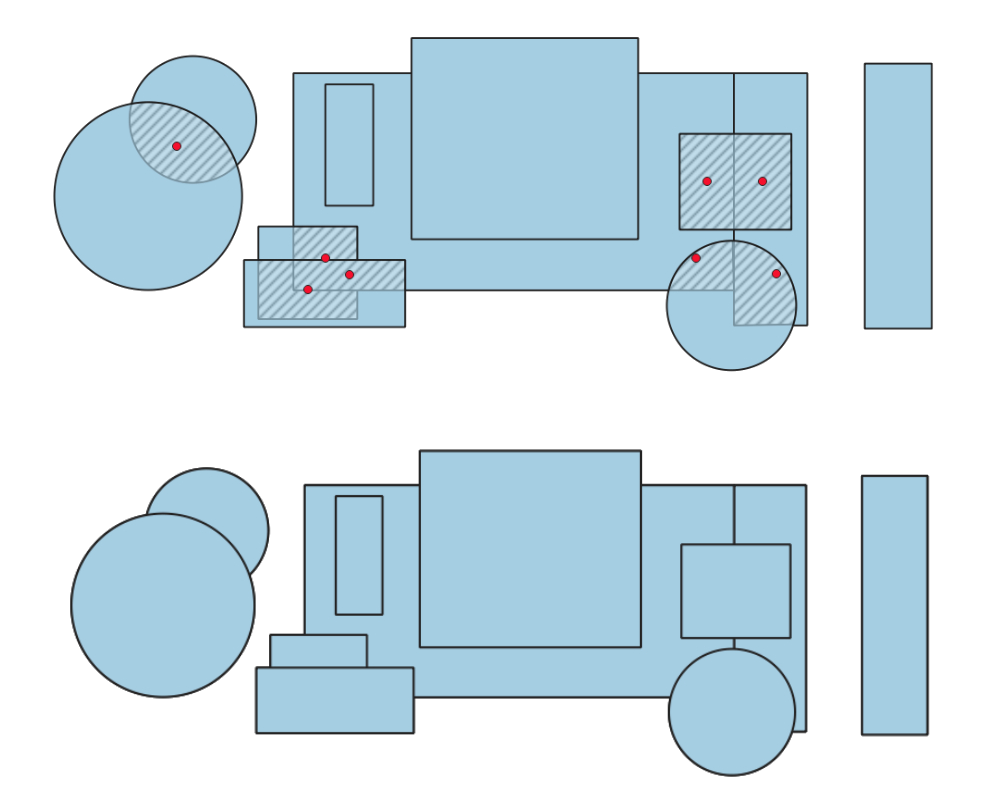
Abb. 24.18 Deleting overlapping areas.
Parameter
Grundlegende Parameter
Bezeichnung |
Name |
Typ |
Beschreibung |
|---|---|---|---|
Eingabelayer |
|
[Vektor: Polygon] |
Layer with the geometries to fix, same as input in the check algorithm. |
Error layer |
|
[Vektor: Punkt] |
Point layer with the errors location, generated by the check algorithm. |
Field of original feature unique identifier |
|
[tablefield: any] |
Field storing unique values for feature identification in input layer, as set in the check algorithm. |
Field of overlap feature unique identifier |
|
[tablefield: any] |
Field storing unique values for the overlapping feature identification in input layer, as set in the check algorithm. |
Field of error value |
|
[tablefield: any] |
Field storing the error value for each feature, as set in the check algorithm. |
No-overlap layer |
|
[Vektor: Polygon] Standard: |
Specification of the output layer containing fixed features. One of:
Die Kodierung der Datei kann ebenfalls hier geändert werden. |
Report layer from fixing overlaps |
|
[Vektor: Punkt] Standard: |
Specification of the output layer containing the fixes location. One of:
Die Kodierung der Datei kann ebenfalls hier geändert werden. |
Fortgeschrittene Parameter
Bezeichnung |
Name |
Typ |
Beschreibung |
|---|---|---|---|
Tolerance |
|
[numerisch: Ganzzahl] Default: 8 |
Numerical precision of geometric operations, given as an integer n, meaning that two vertices less than 10-n apart (in map units) are considered to be merged. |
Ausgaben
Bezeichnung |
Name |
Typ |
Beschreibung |
|---|---|---|---|
Report layer from fixing overlaps |
|
[Vektor: Punkt] |
Output point layer representing the error locations and fix applied. The output layer contains the following fields:
|
No-overlap layer |
|
[Vektor: Polygon] |
Output layer with input features edited. Overlapping areas reported as errors are removed. The layer contains the same fields as in the input layer. |
Python-Code
Algorithm ID: native:fixgeometryoverlap
import processing
processing.run("algorithm_id", {parameter_dictionary})
Die Algorithmus-Kennung wird angezeigt, wenn Sie den Mauszeiger über den Algorithmus in der Verarbeitungs-Werkzeugkiste bewegen. Die Parameter-Liste (parameter_dictionary) enthält die Namen und Werte der Parameter. Siehe Verarbeitungs-Algorithmen von der Konsole aus verwenden für Details zur Ausführung von Verarbeitungsalgorithmen über die Python-Konsole.
24.1.6.6. Delete small angles
Added in 3.42
Deletes vertices based on an error layer from the Small angles algorithm. When deletion of a vertex results in a duplicate vertex (when a spike vertex is deleted), the duplicate vertex is deleted to keep a single vertex and preserve topology.
Achtung
This algorithm removes the vertex at the reported small angles, generating new segments that may form a new small angle.
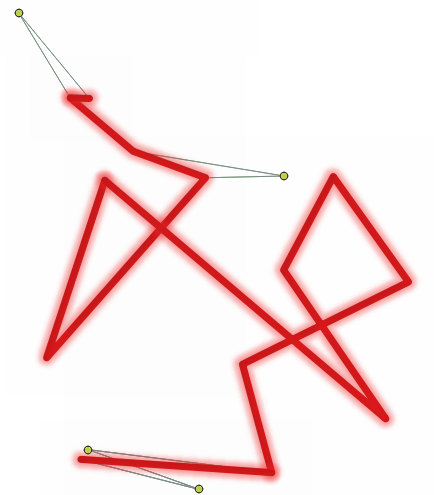
Abb. 24.19 Fixing reported errors on a line feature for angles lower than 15°.
Parameter
Grundlegende Parameter
Bezeichnung |
Name |
Typ |
Beschreibung |
|---|---|---|---|
Eingabelayer |
|
[vector: line, polygon] |
Layer with the geometries to fix, same as input in the check algorithm |
Error layer |
|
[Vektor: Punkt] |
Point layer with the errors location, generated by the check algorithm |
Field of original feature unique identifier |
|
[tablefield: any] |
Field storing unique values for feature identification in input layer, as set in the check algorithm |
Field of part index |
|
[tablefield: integer] Default: |
Field storing the erroneous feature’s geometry part number. |
Field of ring index |
|
[tablefield: integer] Default: |
Field storing the erroneous feature’s geometry ring number. |
Field of vertex index |
|
[tablefield: integer] Default: |
Field storing the erroneous feature’s geometry vertex number. |
Small angle fixed layer |
|
[vector: same as input] Standard: |
Specification of the output layer containing fixed features. One of:
Die Kodierung der Datei kann ebenfalls hier geändert werden. |
Report layer from fixing small angles |
|
[Vektor: Punkt] Standard: |
Specification of the output layer containing the fixes location. One of:
Die Kodierung der Datei kann ebenfalls hier geändert werden. |
Fortgeschrittene Parameter
Bezeichnung |
Name |
Typ |
Beschreibung |
|---|---|---|---|
Tolerance |
|
[numerisch: Ganzzahl] Default: 8 |
Numerical precision of geometric operations, given as an integer n, meaning that two vertices less than 10-n apart (in map units) are considered to be merged. |
Ausgaben
Bezeichnung |
Name |
Typ |
Beschreibung |
|---|---|---|---|
Report layer from fixing small angles |
|
[Vektor: Punkt] |
Output point layer representing the error locations and fix applied. The output layer contains the following fields:
|
Small angle fixed layer |
|
[wie Eingabe] |
Output layer with the geometry fix applied to the input features. The layer contains the same fields as in the input layer. |
Python-Code
Algorithm ID: native:fixgeometryangle
import processing
processing.run("algorithm_id", {parameter_dictionary})
Die Algorithmus-Kennung wird angezeigt, wenn Sie den Mauszeiger über den Algorithmus in der Verarbeitungs-Werkzeugkiste bewegen. Die Parameter-Liste (parameter_dictionary) enthält die Namen und Werte der Parameter. Siehe Verarbeitungs-Algorithmen von der Konsole aus verwenden für Details zur Ausführung von Verarbeitungsalgorithmen über die Python-Konsole.
24.1.6.7. Fill gaps
Added in 3.42
Fills the gaps based on a gap and neighbors layer from the Small gaps algorithm. Three different fixing methods are available.
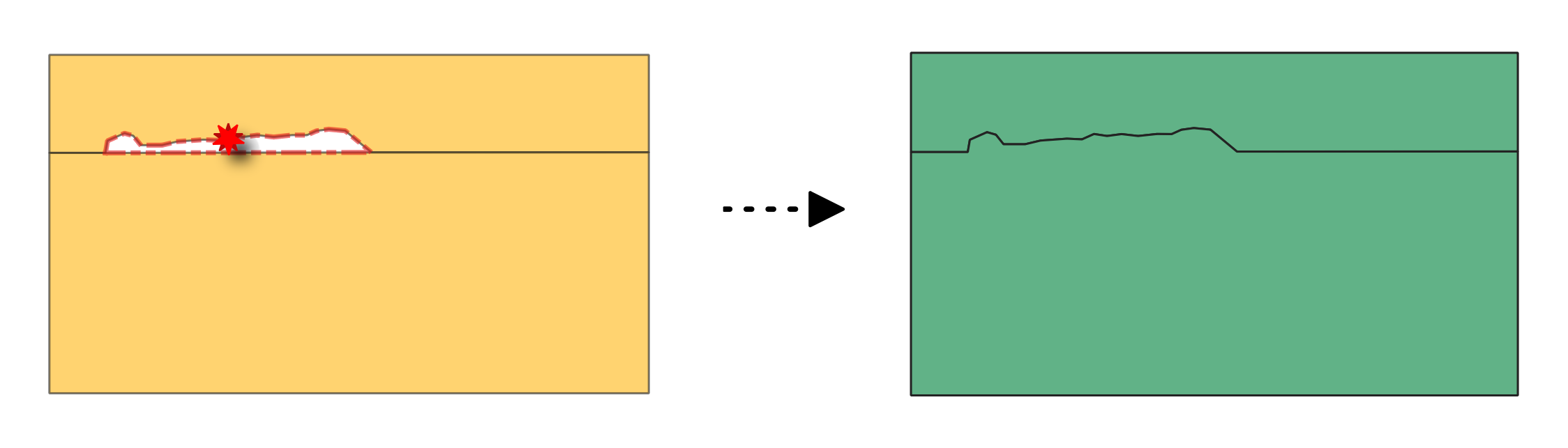
Abb. 24.20 Fixing gap between polygon features using the Add to largest neighbouring area method.
Parameter
Grundlegende Parameter
Bezeichnung |
Name |
Typ |
Beschreibung |
|---|---|---|---|
Eingabelayer |
|
[Vektor: Polygon] |
Layer with the geometries to fix, same as input in the check algorithm. |
Neighbors layer |
|
[vector: table] |
Relational table with the unique ID of the gap and its neighbors in input layer, generated by the check algorithm. |
Gaps layer |
|
[Vektor: Polygon] |
Polygon layer with the gaps geometries, generated by the check algorithm. |
Methode |
|
[Aufzählung] Standard: 0 |
Method to apply to the gap fixing. Possible values are:
|
Field of original feature unique identifier |
|
[tablefield: any] Default: gc_errorid |
Field storing unique values for feature identification in input layer, as set in the check algorithm. |
Field of error id |
|
[tablefield: any] |
Field storing the error ID for each gap, as output by the check algorithm. |
Gaps-filled layer |
|
[Vektor: Polygon] Standard: |
Specification of the output layer containing fixed features. One of:
Die Kodierung der Datei kann ebenfalls hier geändert werden. |
Report layer from fixing gaps |
|
[Vektor: Punkt] Standard: |
Specification of the output layer containing the fixes location. One of:
Die Kodierung der Datei kann ebenfalls hier geändert werden. |
Fortgeschrittene Parameter
Bezeichnung |
Name |
Typ |
Beschreibung |
|---|---|---|---|
Tolerance |
|
[numerisch: Ganzzahl] Default: 8 |
Numerical precision of geometric operations, given as an integer n, meaning that two vertices less than 10-n apart (in map units) are considered to be merged. |
Ausgaben
Bezeichnung |
Name |
Typ |
Beschreibung |
|---|---|---|---|
Report layer from fixing gaps |
|
[Vektor: Punkt] |
Output point layer representing the error locations and fix applied. The output layer contains the following fields:
|
Gaps-filled layer |
|
[Vektor: Polygon] |
Output layer of polygons without gaps. The layer contains the same fields as in the input layer. |
Python-Code
Algorithm ID: native:fixgeometrygap
import processing
processing.run("algorithm_id", {parameter_dictionary})
Die Algorithmus-Kennung wird angezeigt, wenn Sie den Mauszeiger über den Algorithmus in der Verarbeitungs-Werkzeugkiste bewegen. Die Parameter-Liste (parameter_dictionary) enthält die Namen und Werte der Parameter. Siehe Verarbeitungs-Algorithmen von der Konsole aus verwenden für Details zur Ausführung von Verarbeitungsalgorithmen über die Python-Konsole.
24.1.6.8. Fill holes
Added in 3.42
Deletes holes in polygon geometries based on an error layer from the Holes algorithm.
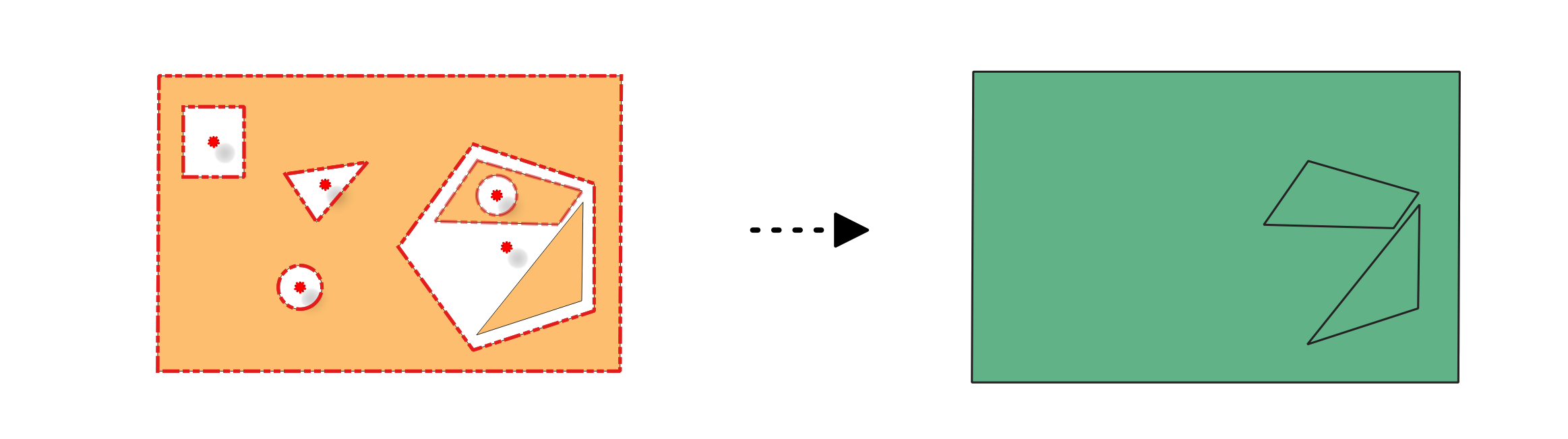
Abb. 24.21 Deleting holes in a polygon feature.
Siehe auch
Parameter
Grundlegende Parameter
Bezeichnung |
Name |
Typ |
Beschreibung |
|---|---|---|---|
Eingabelayer |
|
[vector: line, polygon] |
Layer with the geometries to fix, same as input in the check algorithm |
Error layer |
|
[Vektor: Punkt] |
Point layer with the errors location, generated by the check algorithm |
Field of original feature unique identifier |
|
[tablefield: any] |
Field storing unique values for feature identification in input layer, as set in the check algorithm |
Field of part index |
|
[tablefield: integer]
Default: |
Field storing the erroneous feature’s geometry part number. |
Field of ring index |
|
[tablefield: integer] Default: |
Field storing the erroneous feature’s geometry ring number. |
Field of vertex index |
|
[tablefield: integer] Default: |
Field storing the erroneous feature’s geometry vertex number. |
Holes-filled layer |
|
[Vektor: Polygon] Standard: |
Specification of the output layer containing fixed features. One of:
Die Kodierung der Datei kann ebenfalls hier geändert werden. |
Report layer from fixing holes |
|
[Vektor: Punkt] Standard: |
Specification of the output layer containing the fixes location. One of:
Die Kodierung der Datei kann ebenfalls hier geändert werden. |
Fortgeschrittene Parameter
Bezeichnung |
Name |
Typ |
Beschreibung |
|---|---|---|---|
Tolerance |
|
[numerisch: Ganzzahl] Default: 8 |
Numerical precision of geometric operations, given as an integer n, meaning that two vertices less than 10-n apart (in map units) are considered to be merged. |
Ausgaben
Bezeichnung |
Name |
Typ |
Beschreibung |
|---|---|---|---|
Report layer from fixing holes |
|
[Vektor: Punkt] |
Output point layer representing the error locations and fix applied. The output layer contains the following fields:
|
Holes-filled layer |
|
[Vektor: Polygon] |
Output layer of polygons without holes. The layer contains the same fields as in the input layer. |
Python-Code
Algorithm ID: native:fixgeometryhole
import processing
processing.run("algorithm_id", {parameter_dictionary})
Die Algorithmus-Kennung wird angezeigt, wenn Sie den Mauszeiger über den Algorithmus in der Verarbeitungs-Werkzeugkiste bewegen. Die Parameter-Liste (parameter_dictionary) enthält die Namen und Werte der Parameter. Siehe Verarbeitungs-Algorithmen von der Konsole aus verwenden für Details zur Ausführung von Verarbeitungsalgorithmen über die Python-Konsole.
24.1.6.9. Fix small polygons
Added in 3.42
Merges neighboring polygons according to the chosen method, based on an error layer from the Small polygons or Sliver polygons algorithm.
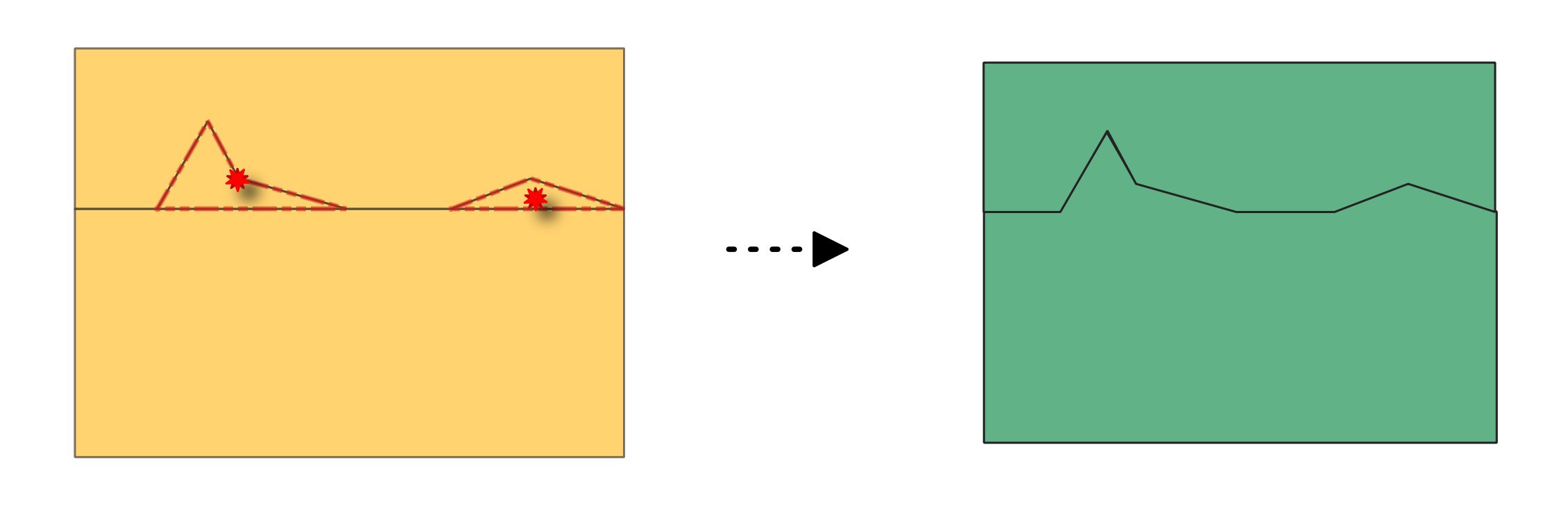
Abb. 24.22 Before and after fixing small polygons (method: merge with neighboring polygon with largest area).
Parameter
Grundlegende Parameter
Bezeichnung |
Name |
Typ |
Beschreibung |
|---|---|---|---|
Eingabelayer |
|
[Vektor: Polygon] |
Layer with the geometries to fix, same as input in the check algorithm. |
Error layer |
|
[Vektor: Punkt] |
Point layer with the errors location, generated by the check algorithm. |
Methode |
|
[Aufzählung] Standard: 0 |
Method to apply to the small polygon geometries:
|
Field to consider when merging polygons with the identical attribute method Optional |
|
[tablefield: any] |
Field in the input layer to consider when merging polygons with the identical attribute method. |
Field of original feature unique identifier |
|
[tablefield: any] |
Field storing unique values for feature identification in input layer, as set in the check algorithm. |
Field of part index |
|
[tablefield: integer]
Default: |
Field storing the erroneous feature’s geometry part number. |
Field of ring index |
|
[tablefield: integer] Default: |
Field storing the erroneous feature’s geometry ring number. |
Field of vertex index |
|
[tablefield: integer] Default: |
Field storing the erroneous feature’s geometry vertex number. |
Small polygons merged layer |
|
[Vektor: Polygon] Standard: |
Specification of the output layer containing fixed features. One of:
Die Kodierung der Datei kann ebenfalls hier geändert werden. |
Report layer from merging small polygons |
|
[Vektor: Punkt] Standard: |
Specification of the output layer containing the fixes location. One of:
Die Kodierung der Datei kann ebenfalls hier geändert werden. |
Fortgeschrittene Parameter
Bezeichnung |
Name |
Typ |
Beschreibung |
|---|---|---|---|
Tolerance |
|
[numerisch: Ganzzahl] Default: 8 |
Numerical precision of geometric operations, given as an integer n, meaning that two vertices less than 10-n apart (in map units) are considered to be merged. |
Ausgaben
Bezeichnung |
Name |
Typ |
Beschreibung |
|---|---|---|---|
Report layer from merging small polygons |
|
[Vektor: Punkt] |
Output point layer representing the error locations and fix applied. The output layer contains the following fields:
|
Small polygons merged layer |
|
[Vektor: Polygon] |
Output layer of polygons with small polygons merged according to the chosen method. The layer contains the same fields as in the input layer. |
Python-Code
Algorithm ID: native:fixgeometryarea
import processing
processing.run("algorithm_id", {parameter_dictionary})
Die Algorithmus-Kennung wird angezeigt, wenn Sie den Mauszeiger über den Algorithmus in der Verarbeitungs-Werkzeugkiste bewegen. Die Parameter-Liste (parameter_dictionary) enthält die Namen und Werte der Parameter. Siehe Verarbeitungs-Algorithmen von der Konsole aus verwenden für Details zur Ausführung von Verarbeitungsalgorithmen über die Python-Konsole.
24.1.6.10. Split self-intersecting geometries
Added in 3.42
Splits self-intersecting geometries based on an error layer from the Self-intersections algorithm.
Bemerkung
This algorithm detects invalid polygon geometries (self-intersections).
To ensure these invalid features are not filtered out before processing, open
 Advanced options next to the Input layer and set
Invalid feature filtering to
Advanced options next to the Input layer and set
Invalid feature filtering to Do not Filter (Better Performance).
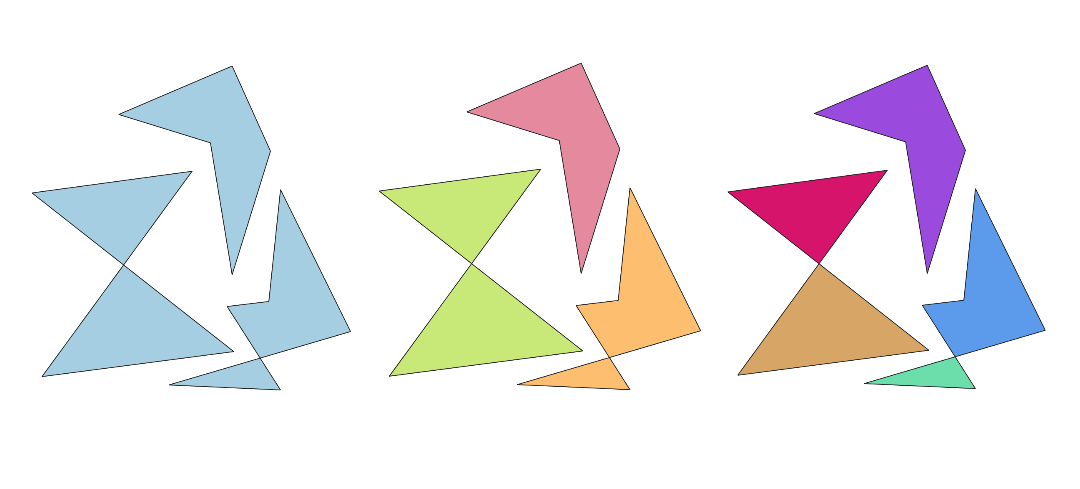
Abb. 24.23 Fixing self-intersection using various methods: as multi-part (middle), and multiple single-part geometries (right).
Parameter
Grundlegende Parameter
Bezeichnung |
Name |
Typ |
Beschreibung |
|---|---|---|---|
Eingabelayer |
|
[vector: line, polygon] |
Layer with the geometries to fix, same as input in the check algorithm |
Error layer |
|
[Vektor: Punkt] |
Point layer with the errors location, generated by the check algorithm |
Methode |
|
[Aufzählung] |
Method to apply to the self-intersecting geometries:
|
Field of original feature unique identifier |
|
[tablefield: any] |
Field storing unique values for feature identification in input layer, as set in the check algorithm |
Field of part index |
|
[tablefield: integer] Default: |
Field storing the erroneous feature’s geometry part number. |
Field of ring index |
|
[tablefield: integer] Default: |
Field storing the erroneous feature’s geometry ring number. |
Field of vertex index |
|
[tablefield: integer] Default: |
Field storing the erroneous feature’s geometry vertex number. |
Field of segment 1 |
|
[tablefield: integer] Default: |
Field storing the number of the first segment involved in the erroneous intersection. |
Field of segment 2 |
|
[tablefield: integer] Default: |
Field storing the number of the second segment involved in the erroneous intersection. |
Self-intersections fixed layer |
|
[vector: same as input] Standard: |
Specification of the output layer containing fixed features. One of:
Die Kodierung der Datei kann ebenfalls hier geändert werden. |
Report layer from fixing self-intersections |
|
[Vektor: Punkt] Standard: |
Specification of the output layer containing the fixes location. One of:
Die Kodierung der Datei kann ebenfalls hier geändert werden. |
Fortgeschrittene Parameter
Bezeichnung |
Name |
Typ |
Beschreibung |
|---|---|---|---|
Tolerance |
|
[numerisch: Ganzzahl] Default: 8 |
Numerical precision of geometric operations, given as an integer n, meaning that two vertices less than 10-n apart (in map units) are considered to be merged. |
Ausgaben
Bezeichnung |
Name |
Typ |
Beschreibung |
|---|---|---|---|
Report layer from fixing self-intersections |
|
[Vektor: Punkt] |
Output point layer representing the error locations and fix applied. The output layer contains the following fields:
|
Self-intersections fixed layer |
|
[vector: same as input] |
Output layer with the geometry fix applied to the input features. The layer contains the same fields as in the input layer. |
Python-Code
Algorithm ID: native:fixgeometryselfintersection
import processing
processing.run("algorithm_id", {parameter_dictionary})
Die Algorithmus-Kennung wird angezeigt, wenn Sie den Mauszeiger über den Algorithmus in der Verarbeitungs-Werkzeugkiste bewegen. Die Parameter-Liste (parameter_dictionary) enthält die Namen und Werte der Parameter. Siehe Verarbeitungs-Algorithmen von der Konsole aus verwenden für Details zur Ausführung von Verarbeitungsalgorithmen über die Python-Konsole.